



K-pop’s globalization is not an overnight sensation. Today, it’s truly global in the sense that an artist may have a fan on every continent.
In the early days however, Korean media often equated certain global music markets as the “world”. Stars leading Hallyu (The Korean Wave) would be heralded as “world stars”, even though the idea of “world” may have meant China, Japan, and then Asia before the U.S. projects were publicized in the mid-2000s. While some today frame this as seeking Western validation, business objectives tell a different story. Bigger exposure, wider fanbases, exponentially more money.
The early deals shouldn't be judged by today's standards. Different times - no social media, old school networking in an already niche industry, and no pre-conceived, mainstream notion of what Korean pop music was.
How did K-pop “break” America? Or did America “come around” to K-pop? I dissect K-pop’s international deal structures in the U.S. throughout the years— what was attempted, what was learned, and finally, what worked.
Act I: The Wild West
The talent ventured out while the Korean public speculated. The U.S. was mostly disinterested but some were intrigued.
This part involves the “Big 3” labels of the mid-2000s - SM, JYP, and YG Entertainment.
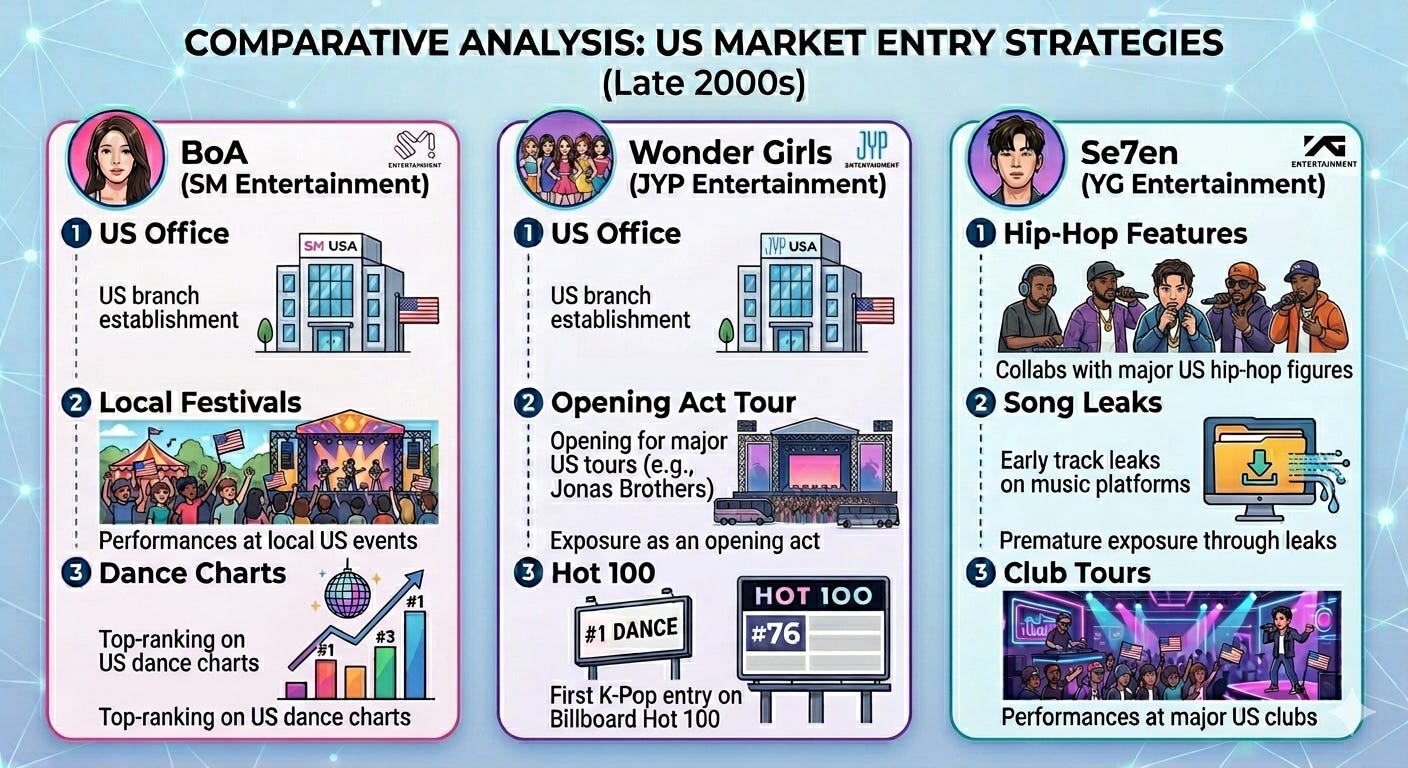
By the late-2000s, there was plenty of speculation in the Korean media whether the media headline “미국진출 / U.S. Expansion” into the biggest music market was indeed feasible. Park Jin-Young, the figurehead behind JYP Entertainment, had set up a NYC office, publicized his U.S.-based talent Lim Jeong Hee, Min (later of Miss A fame) and G.Soul. Park enthusiastically emphasized co-signs from OutKast, Lil Jon, and R.Kelly but unfortunately, plans were eventually scrapped by the 2008 financial crisis.
Two years later, Park would try again with Wonder Girls, who were already household names in Korea off hits especially “Nobody”.
In 2009, Wonder Girls joined the Jonas Brothers on a nationwide U.S. tour as openers with CAA as agent. But there was no formal U.S. label deal behind it. Park himself brokered local promotion and distribution directly. Single CDs of “Nobody” distributed to children’s clothing stores, grassroots pop-up shows, and by some accounts Park and the members personally handed out flyers and CDs to fans to make up for lack of radioplay and TV broadcasts. By the end in 2009 though, “Nobody” was one of the best-selling singles sold in the U.S. and Wonder Girls become the FIRST K-pop act to chart on the Billboard Hot 100. But domestic momentum never quite recovered, and the window they'd built in Korea started closing.
SM Entertainment also launched a U.S. debut project the same year for BoA, already a marquee artist in Korea and Japan. SM invested heavily in localization - a LA office, global songwriters to pen the lead single and studio album. But without a major U.S. label counterpart, promotions mostly consisted of a few televised local events, a sharp contrast to BoA’s stadium tours in Asia. Eventually after a MTV performance and minor commercial success (#127 on Billboard 200), BoA returned home and made a domestic comeback in 2010, 5 long years after her last studio album.
Se7en, a solo artist from YG Entertainment had the charming looks, high-pitched vocals, and flawless dance skills of an Asian star. Given YG’s strong roots in hip-hop, Se7en had secured co-signs from the likes of Lil’ Kim, Fabolous, and Three 6 Mafia. Yet with early song leaks undermining traction, lack of a local presence, and a looming U.S. record deal that never fully executed to fruition, Se7en spent 3 years in limbo before also returning home and making a comeback in 2010.
Wooski’s Note: In hindsight, all 3 talented artists would’ve benefited from a formal U.S. distribution deal handling ALL aspects of local album marketing & promo. Or perhaps, a decently-structured joint venture with a shared vision. But Korean labels didn’t have much leverage. The American counterparts likely didn’t properly understand the target audience and the general demand for Korean-branded talent was much less back then. The financial crisis didn’t help.
Act II: The Market Comes to You
The talent delivered and market reacted. But there is an infrastructure problem.
Here we’ll discuss the viral moments, the hot reactions, and why this wasn’t sustained.
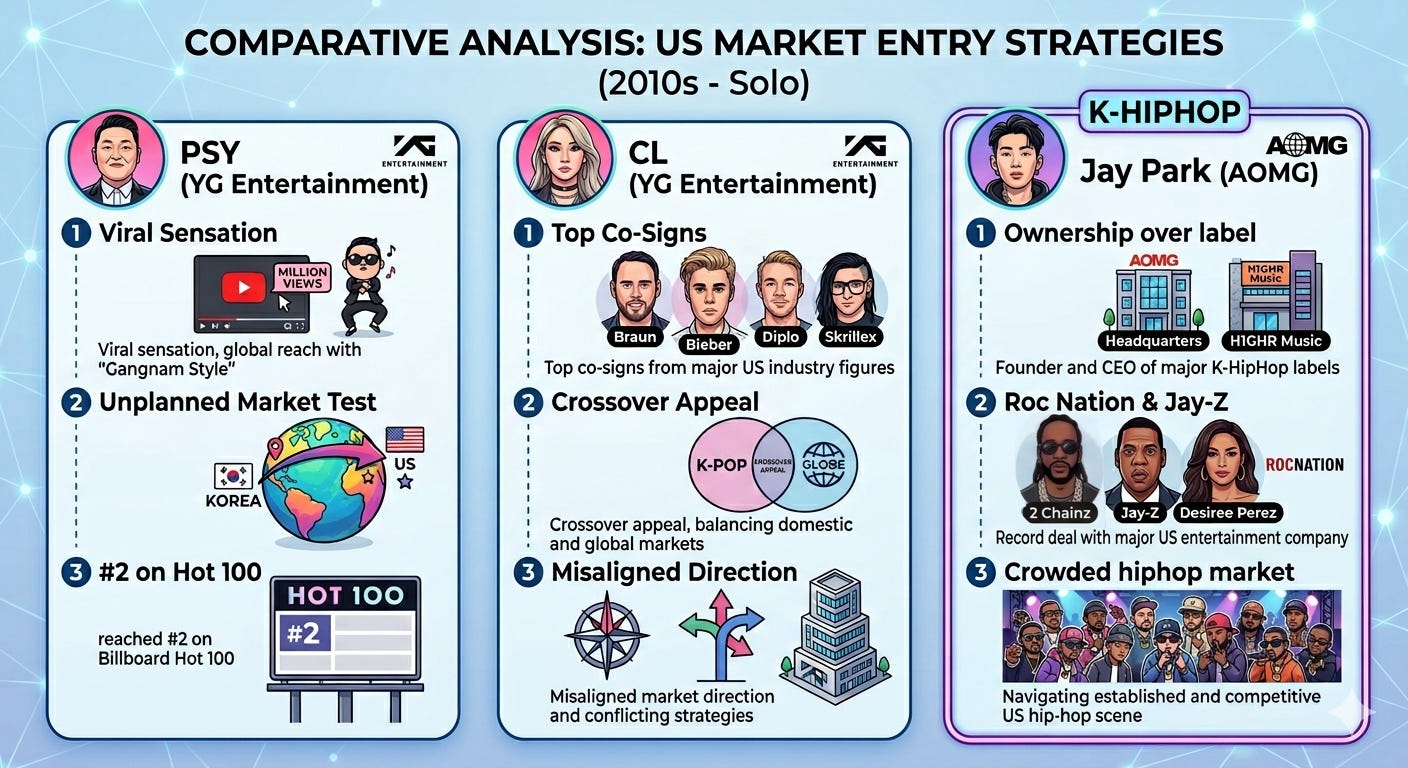
In 2012, something happened that nobody in the Korean music industry planned for. PSY’s “Gangnam Style” was truly a viral YouTube phenomenon breaking through not just America but the world. There was no label deal in place, a radio campaign, or a meticulous rollout. Everything was happening spontaneously and simultaneously on the go.
“Gangnam Style” was a genuine, historic cultural moment. But what really followed showed something Act I above didn’t consider. Having a major hit and a sustained infrastructure are two completely different things. The Scooter Braun management deal that came after Gangnam Style was essentially the industry trying to retroactively structure onto something it didn’t create and couldn’t replicate. Hence, the subsequent works “Gentleman” and “Daddy (feat. CL)” did not have the same impact.
The PSY situation taught us another lesson that’s still relevant today: if you’re operating in a market where something can go viral overnight, you need contingency structures ready before it happens, or at least immediately after. A well-assembled team (including, a music lawyer) along the way will ensure everything’s set to skyrocket. But Gangnam Style was magical precisely because it was unpredictable!
CL’s story is a sharper version of a similar fundamental issue. In March 2015, CL even closed Ultra Music Festival alongside Skrillex, Diplo, and Justin Bieber. She was managed by Scooter Braun and had strong crossover credibility and fanbase as a top K-pop act in 2NE1.1 EVERY factor was there - the charisma, the skills, and the co-signs. And then nothing came out for years. Because the release timeline, the creative approval, and the rollout strategies sat with decisionmakers whose incentives were never fully aligned. A co-release structure with concrete timeline commitments doesn't guarantee a hit, but it at least guarantees something comes out. Where to set the priority is the negotiable point.
Jay Park presented an alternative route. You see, Jay Park’s success as a K-hiphop artist and mogul was a response to the K-pop label system. After getting pushed out of his former JYP K-pop group, Park built his labels from scratch, retained ownership and creativity, and created his own infrastructure in Korea.
From this, it was time in 2017 to align with his American counterpart - Jay-Z’s Roc Nation. The Roc Nation record deal that came after was peer-to-peer in a way that none of the Act 1 deals ever were. It still had a ceiling due to how saturated the hip-hop market was back then, as Park only released 1 EP album. However, I still think it was a different kind of ceiling and presented new paths for an Asian solo act without a massive K-pop label backing.
Wooski’s Note: The CL example in the mid-2010s is the one that still stings structurally. When you’re bringing an artist with an existing fanbase and proven crossover appeal into a deal, the leverage dynamic is different from a development deal, and the contract should reflect that. Hard release commitments, mutual approval rights on creative, and genuine penalties for inaction aren’t aggressive asks in that context. They’re just table stakes.
Act III: Owning the Machine
The talent and labels are aligned for takeoff. The machine is in full swing.
By the late 2010s into the 2020s, the global K-pop phenomenon is in full swing and the question is no longer on whether Korean acts can break the American market. They clearly could! But now the new question was what kind of structure was required to sustain it, and who owned it. Three acts define this era, each with a different answer.2
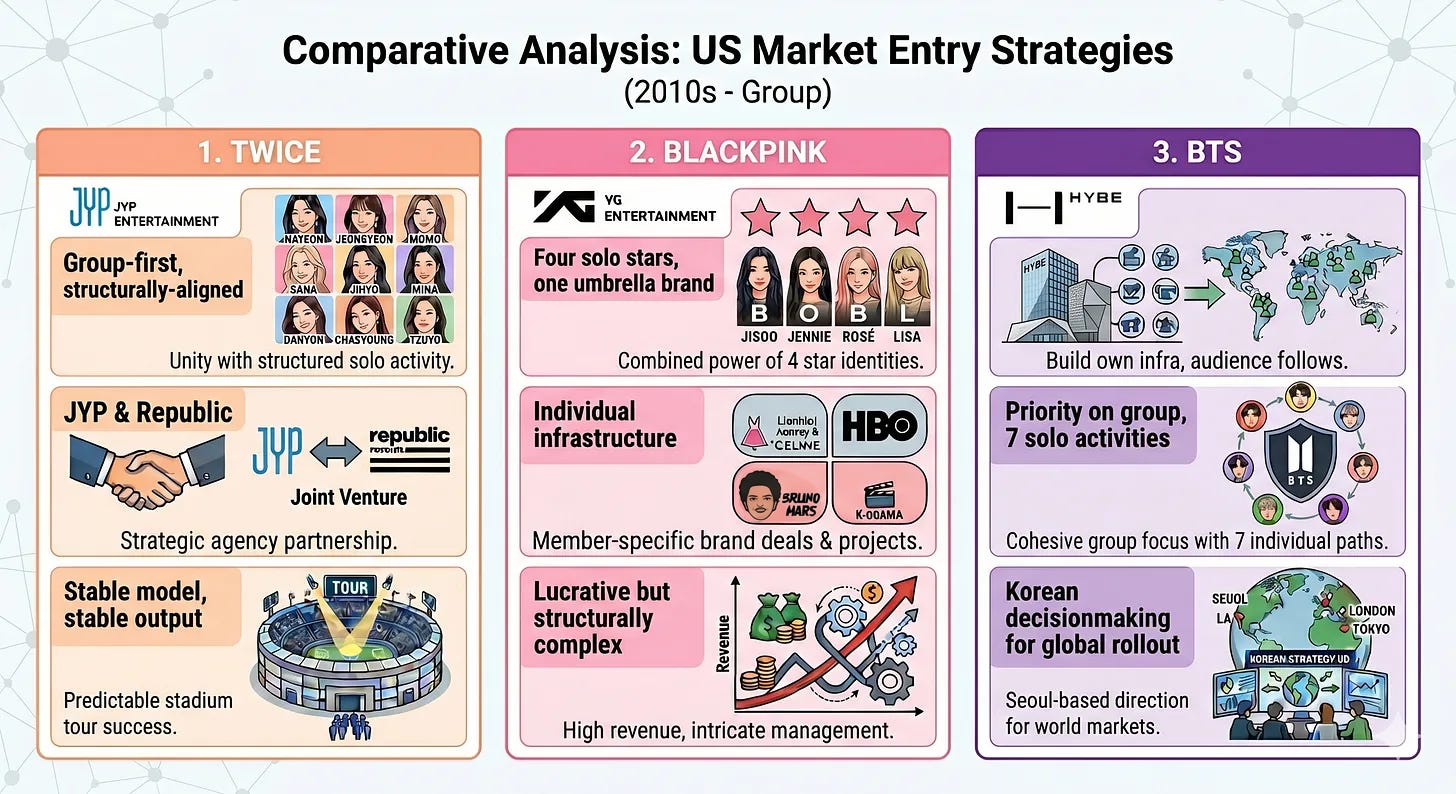
JYP’s girl group TWICE, celebrating a decade+ of activity, represents a cleanly aligned label model. From the start, TWICE was produced as a group-first act in 2015 with a huge catalog of global hits through the years. Solo activities started 7 years later in 2022 (which is the norm), but always feed back into the strong group identity. All 9 members renewed their JYP contracts.3
Consequently, the JYP and Republic Records partnership pays off very visibly with stable success. Formal distribution arrangement, coordinated rollouts, topped off with a KPop Demon Hunters placement, 2025 Lollapalooza headliner act, and U.S. stadium tours. The joint venture extends into JYP’s top roster artists ITZY and Stray Kids. Despite early songs and image catering more to the Asian market, TWICE’s mature transition has been successful with loyal fans and newer inflow from the Western audiences.
In comparison, BLACKPINK is structurally different. YG didn’t just produce a K-pop group. After years of dominant group and solo activity, it feels today that there are 4 individual superstars who also happen be in the same group. Successful solo careers, luxury fashion houses, Met Gala (all 4 in 2026), collaborations with The Weekend or Bruno Mars, and acting in HBO/Netflix are not side projects. They are core to what BLACKPINK is commercially in every creative industry. At the climax of it all, the group functions as an umbrella brand for 4 solo careers. Of course, this is very lucrative for all involved, but structurally complicated as there are many stakeholders with YG, Interscope Records (group activity only), and the members’ individual agencies and U.S. record labels.
To cap off this section, BTS and HYBE (BigHit Music) are the answer to what their predecessors identified as broken. The idea of negotiating for better terms with a US major label is only secondary, and at times irrelevant. BTS and HYBE created this infrastructure themselves from the onset, and the later UMG relationship would be structured as exclusive distribution, not creative control. At this scale, you stop asking for permission and start building the channels yourself. This was only possible because the the artist, label, and fandom believed in and complemented each other.
Group identity is very strong with BTS. Even a 2-year hiatus of military service goes fast when the group’s “break” is translated into a segway to 7 diverse solo careers. A very rare combo of the Korean artist, label, and dedicated global fandom working in unison to create genuine inbound demand from America. Yet upon their recent comeback <ARIRANG> and its Netflix documentary, I have seen comments whether BTS should part ways with HYBE for a new start. From a structural POV, that would entail a lot of repercussions. The amount of human resources and coordinated effort into a rollout of this scale is massive. Whether that can be replicated outside the HYBE machine is worth discussing, and I recommend reading Christine Su’s piece that contemplates BTS’s economics for further in-depth analysis.
Wooski’s Note: What happens to group obligations when a solo career reaches a certain scale apart from the group? TWICE avoids this tension from its roots, while BLACKPINK is complementary of both. BTS carved out distinct historic hype that we won’t know if it can be replicated. These are the ideal structural models that most globally successful K-pop artists adopt today - Korean label ownership, American distribution channels, simultaneous global rollouts.
Act IV: Alternatives & What’s Next
The status quo of titans is ongoing, but it’s being rewritten. The machine isn’t for everyone.
In K-pop, ownership - whether of creative control, master recordings, and eventual career direction - overwhelmingly rests upon the label. Naturally so, because the label has invested the money, time, and resources to produce the stars from the trainee period and would ideally fully recoup its investments. That usually take a while, explaining the standard 7-year contract duration. By that point, if everything went according to plan, the artists would have sufficient leverage to discuss how to gain control of their career on another level.
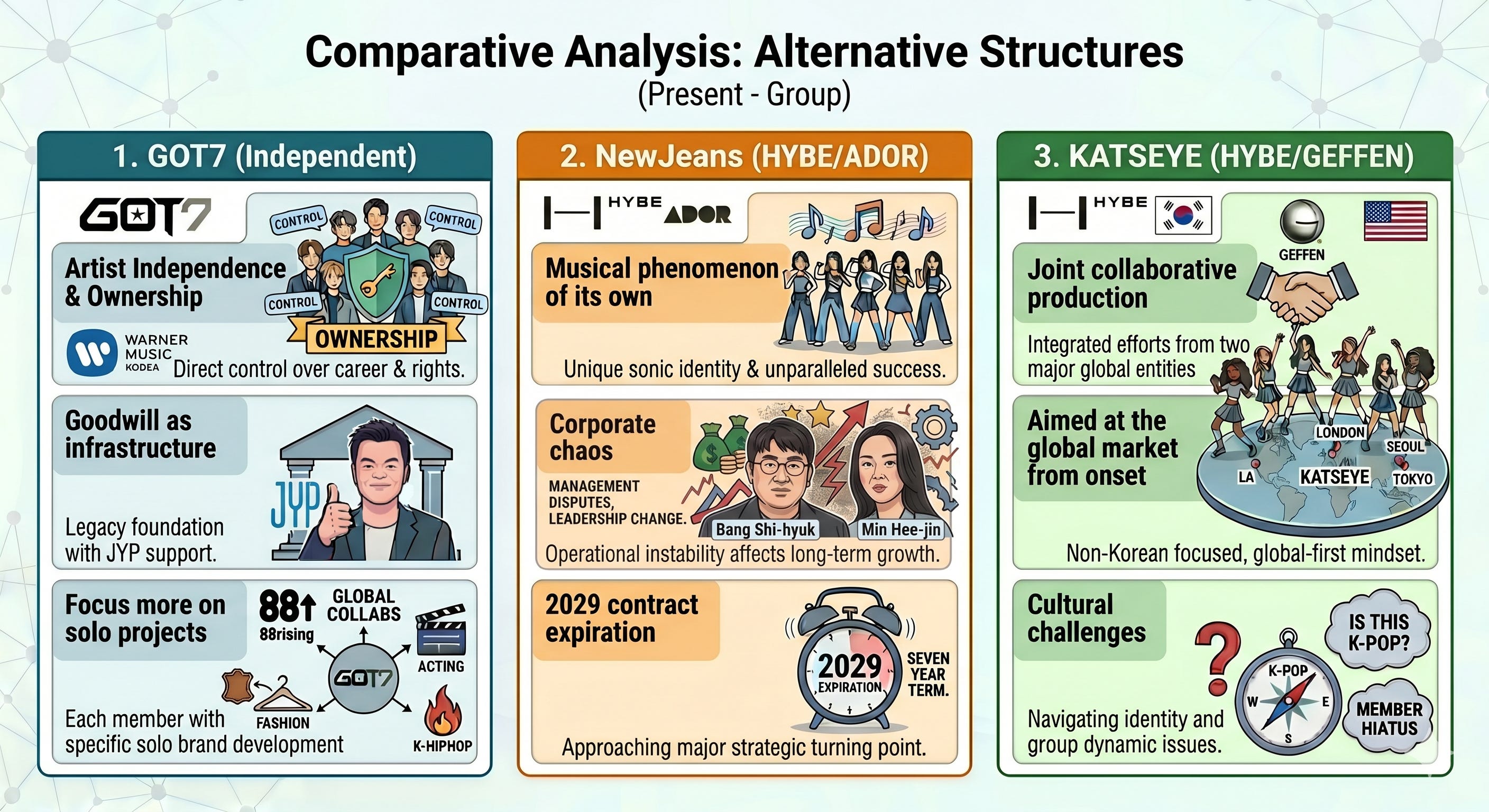
GOT7, a veteran boy band from JYP, tried something different - they went independent4, upon an amicable transfer of IP and creative rights to use its name from JYP. It’s worth discussing what made this possible - 7+ years of label-built production, a long-sustained fandom, and sufficient international star power of each member. We are increasingly seeing more amicable legal transfers of rights upon groups’ departure from the label5, all of them who still thrive and have loyal fans. But this is by no means a blueprint for any K-pop artist, but moreso an exit strategy for a group that already earned its dues within the system. The freedom is genuine, and so is the context that made it possible. Independence is negotiable, but the terms of the transition matter as much as the exit itself.
And then we must discuss NewJeans. This saga is still unresolved, but the ADOR structure was innovative. A creative subsidiary with unusual autonomy under ex-CEO Min Hee-Jin, attracting a kind of talent that wouldn’t thrive in a standard label environment. But it showed that creative autonomy and ownership leverage are dichotomous. Min had the former without the latter, and when the relationship with HYBE & Bang Shi-Hyuk broke down, the structural flaw became a legal one. But whatever the outcome, it will shape how Korean labels structure creative subsidiaries for the next decade. I wonder however, if NewJeans is released from their contract in 2029, will they have leverage to reclaim ownership independently? They attempted in 2025 with “NJZ”, but that’s still an intriguing scenario to think about.
Finally, we close out with KATSEYE, the most structurally novel of the recent cases, and in some ways the most telling about where things are heading. HYBE and Geffen Records didn’t try to bring a Korean act to America. They used the K-pop business model to build a global act from scratch, inside the American market. That’s not market entry. That’s market origination. And it essentially reframes the whole premise of what we long thought about K-pop’s foray into the West.
The story we’re used to — Korean acts building hype simultaneously in Korea and globally, then making the push into America — assumes a starting point outside the market. Now stars are built inside it. This raises the question of whether the “K-pop breaking America” frame is even the right one going forward. The next wave might not come from Korea at all. It will just come from Korean-trained infrastructure, operating locally, in markets that previously had to be broken into. China, Mexico, and UK for starters.
Wooski’s Note: The machine got so good that it started building new machines (like AI/ML?). Where those machines get built next is the more interesting question now. But I believe the status quo will remain, because the demand for traditional K-pop still exists while the pie is getting bigger.
The essence of K-pop still has and should have a Korean-ness to it, but we’ll always pose the never-ending question - “is this K-pop”? How that Korean-ness manifests is up for discussion. On this odyssey of K-pop, onwards we go. Or shall I say, up, up up…
This piece is the most comprehensive look I could put together on K-pop’s U.S. strategies, from the early attempts to what’s being built right now.
Going forward, my newsletter <WooskiWrites> will focus primarily on K-pop, K-culture, and Asian content analyzed through a legal, business, and cultural lens. The upside of being a music lawyer in NYC is getting to observe K-pop from the outside in. All while feeling its impact directly in the scene and doing big-scale legal work deep in the weeds of the American music business.
If you enjoyed this, please share it with your friends and colleagues, and let’s connect - Instagram / LinkedIn. See you soon!
-Wooseok Ki (Wooski)
Of course, CL is still a huge star and big name in the industry. 2021 Met Gala appearance, 2022 2NE1 Coachella reunion, to list a few.
During this time, SM Entertainment also finally succeeded in launching its supergroup SuperM to the top of Billboard 200 with Capitol Records. However I have omitted from this section as structurally, it’s a one-off project.
Leader Nayeon kicked solos off followed by other members and a Japanese sub-unit. The “group-first” approach is largely due to the predecessor Miss A, in which the single member Suzy Bae garnered more popularity than the group itself. That model still generates a lot of revenue, but doesn’t help the group identity.
The latest album in 2025 was distributed by Warner Music Korea.
INFINITE, BTOB, and finally HIGHLIGHT (ex-BEAST. They had to change their name…) to name a few.